
The Hoffman Process

Pre-Hoffman - Home and London
I had heard about the Hoffman Process the first time from a blogger I had been following for years, Aimee Song. I initially dismissed it as a hoax, the same hoax that is acted out in Mad Men. Years later, I stumbled upon a podcast that mentioned how life-changing this personal development course was.
The Hoffman theory premise is about negative love. Bob Hoffman recognised that as children we unconsciously adopt the negative behaviours, belief systems, moods, attitudes and insecurities of our parents in order to be loved. These patterns of behaviour pass from generation to generation, and it is only when we recognise and deal with them that the cycle can be broken.1
For me, amongst many others, I had the heavy feeling that I was living a life without purpose. As a single woman, where work is ok but not amazing, finding purpose is not easy. I had no children to show, no C-job title, no beautiful owned home. That, plus the added series of relationships that had led to learning, but no long-term commitment. Poor old me.
They say, that the Process comes to you, not you to it. It finds you when you need it and are ready for the transformation. I had gone to therapy routinely, was working out, had a steady job. If it’s not now, I didn’t know when, so I signed up.
The hardest part so far wasn’t signing up. It was putting down my credit card number on the website for the payment. The biggest transaction of my life at that point. For something that held a beautiful promise but zero guarantee. I took a deep breath and moved on.
I’d booked my flight to London months earlier, yet even in the week leading up to it, I kept undecided: What would I actually do with those spare days? A simple dinner with a friend felt like the safest choice; an easy evening to steady my nerves. Someone familiar. Someone who could pull me back into myself with a tight embrace.
I spent that first night in London wrapped in an odd, unexpectedly romantic goodbye—one of those dinners that lingers in the air long after the plates are cleared. I remember he held my waist, while glancing from the London Bridge to my eyes. Neither of us sure, if we should kiss for old times' sake or rather save it. A parting that tastes like sweetness on the tongue but settles into something slightly bitter once you swallow. Not exactly the headspace I’d hoped to carry into the days ahead.
The next morning, I dragged myself onto a train bound for Newhaven, a sleepy little shore town that felt suspended in time. The night before the Process, I found myself in a shore pub called the Hope Inn, dinner and a drink my companions. The Hope Inn mirrored in a way my hope of the Process, and reminded me of a simple life in a small town. Maybe part of me craved a slower life. Later, I sank into the bathtub, scents and candles coaxing a sense of comfort I couldn’t summon.
Sleep eluded me when I hit the pillow, as though my body knew what was coming, and wasn’t ready. A message from my London friend, Kai, woke me up “if anything goes south, I’ll drive down to get you. I promise”. All was going to be ok.
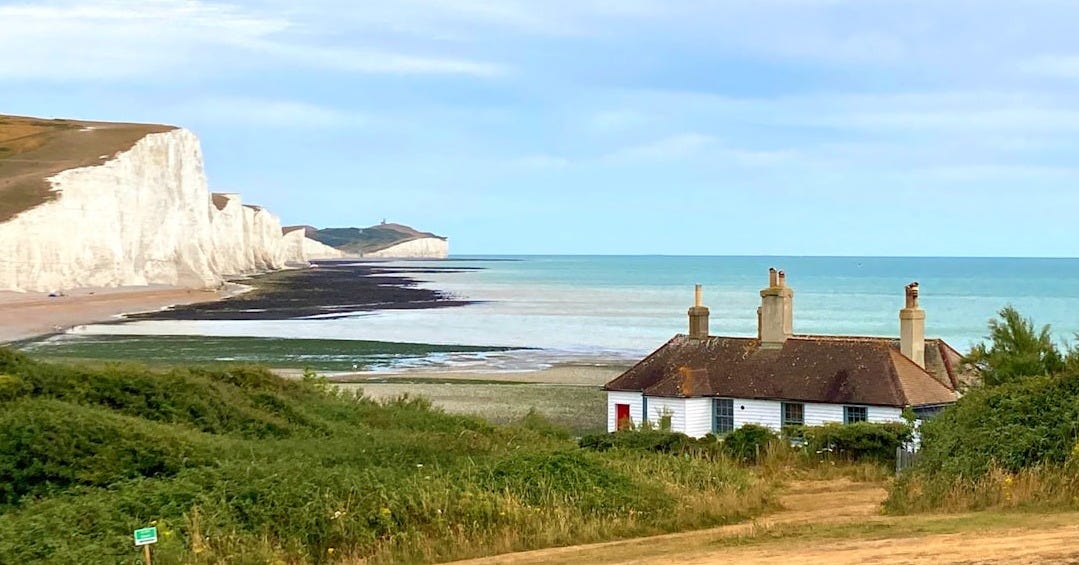
Check-in at the Process venue Florence House, in Seaford was at 9 a.m. The British country mansion greeted me with quiet grandeur, just five minutes from cliffs that fell dramatically into an immense wild sea. I took it in slowly, like a camera panning across a scene. The house had that warm coastal elegance: beige armchairs softened by age, moss-green cushions, salt-touched air drifting through tall windows where the sun fell in long, golden shapes. The workroom smelled faintly of paper, wood, and sea. Chairs were in a half moon, I looked away quickly in slight avoidance.
At the entrance, a loose cluster of participants had already settled in, half-anxious, half-eager, studying one another. A few were already deep in conversation. I knew I was exactly where I belonged.
When I gave my name, Ruth, one of the Hoffman facilitators, she explained my sleeping arrangements and handed me a list of rules. Then she asked for my phone. Panic settled in my stomach. I had forgotten that I’d be without it for a week. In my calmest voice, I asked for a moment to say goodbye to my family. It felt like the last shred of control in a week designed to dissolve it.
When I surrendered the phone, she placed it in a trunk that looked lifted straight out of Harry Potter. That’s when the first weight of release hit me followed by the first wave of anxiety at being unreachable. Oh well.
The Hoffman Process - Seaford, UK.
The Process unfolded in sessions carved by subject and divided into days. Each step, misstep, and emotional carousel you find yourself on, is carefully curated by the Hoffman facilitators.
Serena introduced herself as the director of Hoffman UK. Her presence was a steadying force, holding the swirl of the week in quiet balance. Funny, comical, yet profoundly uplifting, there was something magnetic about her. You felt you could tell her anything—her green-blue eyes holding it all, steady and knowing. Calm and grounded like a tree rooted deep in the earth, she moved through the space always accompanied by Matti, her faithful dog. She guided the other 3 facilitators with effortless ease, inspiring without trying.
In the beginning, we were divided into groups. We tried our hardest to figure out how these groups were made because they felt so intentional. To this day, that must be a Hoffman secret, because we never found out. I loved mine the most.
Eliza, our facilitator, was a tough yet gentle woman, the exact push I needed. I knew immediately she was my mother in disguise. She pushed, questioned, and held me more times than I can count, always with that gentle firmness that cracked something open in me every single time.
I was operating under the assumption that I was there to sort out my love life, find a purpose and go out all bright and healed. That was wrong. Nothing lies to you, like your own mind when you desperately need to believe you are in control of your past.
To my surprise, my biggest unlocked fear wasn’t of rejection or loss, but of danger. Physical danger. Crippling danger. I used to be afraid to fly, afraid of clubs, afraid of the streets at night. During a cathartic exercise, memories I had buried came flooding back.
When I was younger, I once went to a club in Mexico with friends. We were in mini skirts, laughing over drinks, when five men, possibly narcos, entered with AK-47s around their necks. They were looking for someone, they announced, and suddenly the room went silent. The whole club froze. The music muted.
They shot at the floor a few times, stomped around the club, checking every nook, every bathroom stall. And then they left. Three minutes in total, though it felt like a lifetime. “Nothing happened, we are fine”. I remember saying over and over while I held my crying friends.
After that day, fear settled into me like a permanent shadow. I walked through the world on edge. I took cabs instead of walking. I shared my location. My eyes scanned every direction, counting every face, every hand, always looking out. A grip around my throat I didn’t know how to release.
Over the years, I buried this. Never talked about it, as I was fiiiine. A specific sound in the Hoffman unwrapped this, after years of tight packaging. To me, the sound was like gunshots. The shots froze my entire body. It was the only exercise I couldn’t do. I walked out and Ruth came rushing to check on me. She put her hand on my chest, and said “you are safe, you are safe, you are safe”.
Ruth stayed with me with the next few moments, and walked me through a neurological explanation of what had happened. The brain’s response is driven by the way traumatic memories are stored and processed, leading to a reactivation of the original stress response even in the absence of immediate danger, the reaction is the old wound.2 This feeling was at least 15 years old. And I wasn’t even sure if it was real.
The prefrontal cortex, which normally regulates emotions and enables rational decision-making, becomes underactive during these episodes, impairing the brain’s ability to override fear responses and distinguish between past and present threats. Naturally, I wanted to just run away. But Ruth taught me to sit with it. I was safe. Eliza cradled me at the kitchen table as I cried like a baby.
Rushing in came anger toward my parents. Surprise surprise. Why would they chose to raise me in a place like this? Why did they never teach us about danger? or how to react in situations like this? Why was I so emotional and reactive all the time?
This was the seed. The seed that made the tree. The seed that made the leaves grow green and die brown. The seed of the fear, the seed of the purpose. The seed was the answer to almost everything. Fuck me. I did not see that coming.
After this, the rest of the Process felt easy. There was a surrender in me that came with ease, and it rushed through me like rain. It was one of the roughest weeks and the most blessed I’ve had in my short life.
Do yourself a favour, and go to the Hoffman Process.
Post - Hoffman Process - back home
A big part of the Process’ wrap up culminated in a gift for my parents, a gift that made the week’s intensity tangible and real. Something I could both hold and release simultaneously. A letter I gave them, thanking them for every sacrifice they made, forgiveness and all the unconditional love I have for them.
The masterpiece—delicate, frightening, beautiful—was the cherry on top the whole experience. I felt lighter, freer, as if every doubt, every fear, every fragment of resistance had been surrendered.
I am by no means “healed”, after all, it’s a Process.
3 years have passed of the most intense personal development week of my life. It continues to bear fruit in our quad checks. Strange women became safe spaces, strangers became confidants, loved ones, and witnesses. The Hoffman Process in Seaford did not just happen to me—it reshaped the way I inhabit my life, one deep breath at a time.
Hoffman UK website: https://www.hoffmaninstitute.co.uk/about-the-process/
https://university.taylors.edu.my/en/student-life/news/2025/can-trauma-be-rewired-the-science-of-neuroplasticity-and-memory.html
This is a beautiful read, thank you for sharing. Alexander
I actually shed a tear while reading this, it felt too close to home. The writing is so vulnerable, it felt like you were actually reading this to me, in a calm and soft voice. I’m glad you not only went through this process, but you shared it too. Thank you.